



Why HR Leaders Are Switching To AI-Based Recruitment Software
HR leaders today aren’t just exploring AI-based recruitment Software out of curiosity; they’re actively replacing old hiring systems with it because their recruitment challenges have changed faster than traditional tools can keep up. As hiring volumes grow, talent pools expand, and recruitment cycles shrink, companies need faster, smarter, and more accurate ways to hire. This is why ai recruitment software and AI-powered hiring automation have rapidly become the backbone of modern talent acquisition.
Across enterprises, recruitment agencies, and universities, hiring has become increasingly complex, competitive, and data-driven. HR teams now want systems that don’t just track applications; they want a tool that intelligently understands candidate skills, predicts fit, automates repetitive tasks, and improves hiring quality. And this is exactly what AI-based recruitment Software delivers.
Means for Today’s HR Teams
AI isn’t new in recruitment but the way HR teams are using it has changed. Earlier, AI tools were limited to resume parsing or keyword matching. Today’s advanced ai recruiting software does far more: they evaluate skill relevance, score candidate-job fit, automate workflows, and give real-time hiring insights.
Think of AI-based recruitment Software as a more powerful, intelligent version of a traditional ATS. It uses machine learning, natural language processing, and predictive analytics to help you find the right candidates faster and reduce the time wasted on manual tasks.
How It Enhances Traditional Talent Acquisition Systems
Most companies already use some kind of Application Tracking System Software, but the limitations are clear: keyword-based searches miss great candidates, recruiters manually shortlist profiles, and communication delays slow down decisions.
Adding AI on top transforms the entire workflow:
- It interprets resume context, not just keywords
- It ranks candidates based on skill proximity
- It automates coordination and scheduling
- It offers insights instead of plain data
That’s why the shift from ATS to AI is accelerating.
How AI-Based Recruitment Software Works: Step-by-Step
To understand why HR leaders are switching, it helps to see how the process actually works.
Step 1: AI Automatically Screens Resumes
AI reads resumes like a human—identifying skills, years of experience, industry relevance, and achievements. Instead of keyword matching, it uses semantic scoring to understand real capabilities.
Step 2: Intelligent Skill & Role Matching
Whether it’s IT, finance, marketing, or operations, the system maps job requirements to candidate strengths and predicts the likelihood of success.
Step 3: Candidate Ranking & Shortlist Creation
Recruiters instantly receive a prioritized list of the best-fit candidates, helping them hire faster and with more accuracy.
Step 4: Automated Communication & Scheduling
The system updates candidates, schedules interviews, sends reminders, and ensures no one drops off due to poor communication.
Step 5: Analytics & Decision Support
AI tracks performance, identifies bottlenecks, and measures hiring quality. This improves long-term workforce planning.
The Hiring Problems AI-Based Recruitment Software Solves
Modern companies face hiring challenges that didn’t exist a decade ago. Today, the average recruiter handles 150–200 resumes per job role, and according to SHRM, 65% of HR teams say they struggle with hiring speed and quality. Here’s how AI changes the situation:
1. Manual Screening Takes Too Much Time
Without AI, HR teams spend up to 40% of their time screening resumes.
AI reduces this to minutes.
2. Candidate Quality Is Inconsistent
Traditional ATS tools often miss relevant profiles because they rely on keyword-based matching.
AI analyses skills, job roles, experience relevance, and industry context.
3. High-Volume Hiring Creates Chaos
Recruitment agencies, BPOs, and enterprise HR teams handle hundreds of openings at once.
This is where recruitment agencies’ software powered by AI becomes essential.
4. Poor Coordination Slows the Process
Manual emails, delayed responses, and missed follow-ups increase drop-offs.
AI automates:
- Follow-ups
- Interview reminders
- Candidate pipeline tracking
5. Campus Recruitment Is Highly Manual
Colleges receive thousands of student applications.
Using a campus recruitment platform or campus recruitment software powered by AI transforms the process, automating screening, instant shortlisting, and transparent tracking.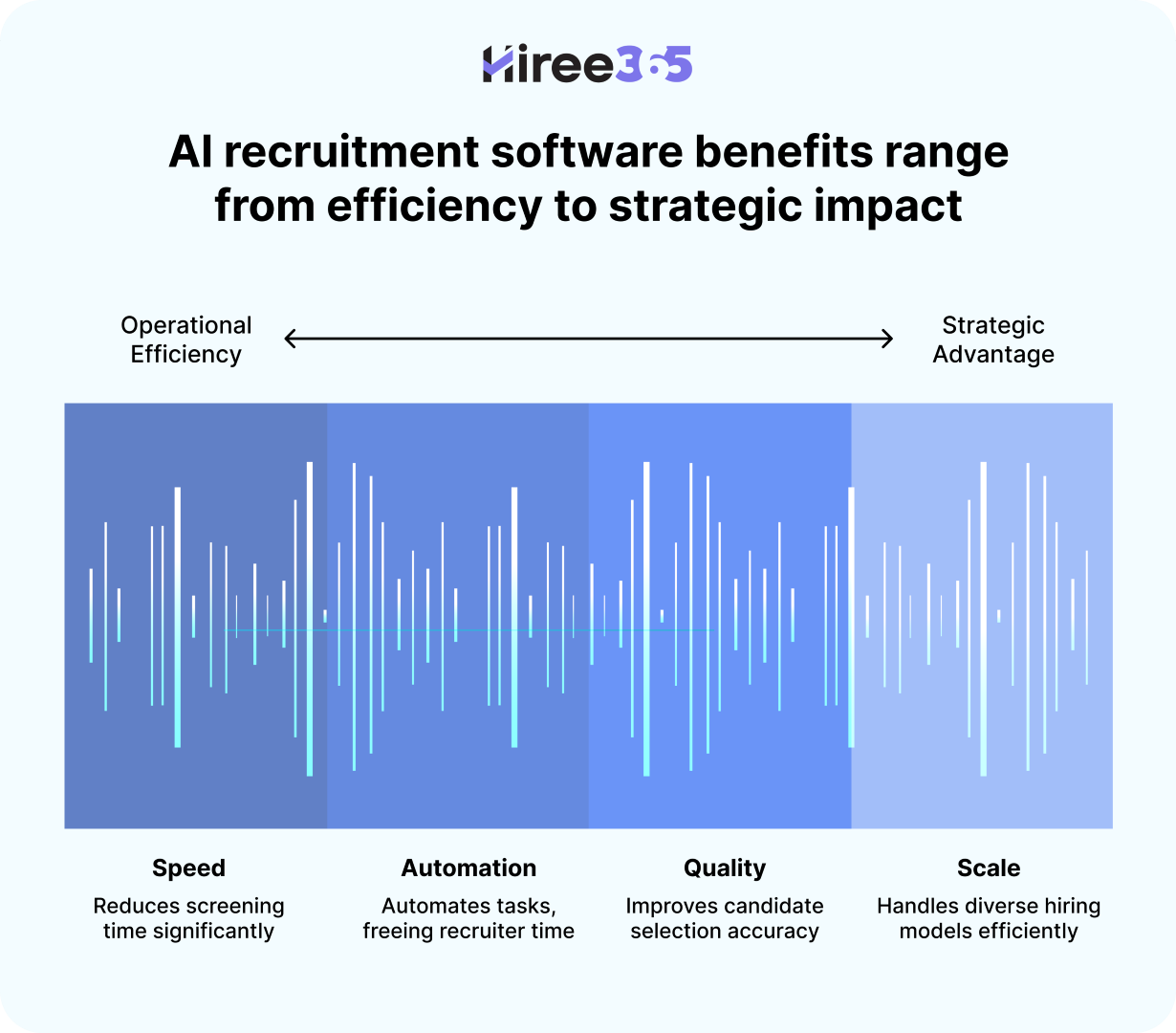
Why AI-Based Recruitment Software Outperforms Traditional ATS Tools
Traditional ATS tools were never built for today’s hiring speed. HR leaders now want intelligence, not just tracking.
AI vs ATS: Key Differences Explained
Below is a high-level comparison of how both systems function. Before choosing between an ATS and an AI hiring platform, it helps to understand how each one processes applications and supports decision-making. While ATS systems focus on organization and tracking, AI systems focus on accuracy, speed, prediction, and reducing manual labour.
| Feature | Traditional ATS | AI-Based Recruitment Software |
| Resume Screening | Keyword-based | Context-based + semantic understanding |
| Shortlisting | Manual | AI-ranked automated lists |
| Candidate Matching | Basic matching | Skill, role, experience & behaviour-based |
| Automation | Limited | Fully automated workflows |
| Candidate Experience | Slow updates | Real-time alerts, chatbots, auto updates |
| Volume Handling | Low | High-volume optimized |
| Campus Hiring | Manual | Fully automated |
| Best For | Basic hiring needs | Fast-growing companies, agencies, and campuses |
Why HR Teams Prefer the AI Software
HR leaders are shifting to AI-based recruitment software because it speeds up hiring, improves accuracy, removes repetitive work, and scales across every hiring model—corporate, agency, and campus. Modern AI recruitment software uses resume parsing, automated shortlisting, AI interviews, and predictive analytics to deliver faster, smarter, and more consistent hiring outcomes.
1. Faster Hiring Cycles
AI instantly handles tasks that slow recruiters down—resume screening, eligibility checks, and candidate ranking.
- Companies see a 60–70% drop in screening time because AI automatically parses resumes and matches skills to JD requirements.
- AI chatbots and automated schedulers reduce follow-ups and manual coordination.
Result: Candidates move through the pipeline faster, improving conversions and reducing drop-offs.
2. Better Quality-of-Hire
AI improves accuracy by scoring candidates based on skills, experience, and role fit instead of gut feeling.
- Predictive analytics identify high-performing candidates early.
- AI interviews ensure consistent evaluation across all applicants.
- Skill-job match algorithms reduce wrong hires and early attrition.
Outcome: Stronger hires backed by data not assumptions.
3. Automation Saves Recruiter Time
AI takes over repetitive recruitment tasks through automated workflows:
- Screening → Shortlisting → Scheduling → Follow-ups
- Email reminders, status updates, and pipeline tracking
- Auto-scoring and structured evaluation
Recruiters can finally focus on interviews, culture fit, and candidate experience instead of paperwork.
Time saved: 40–50% every week.
4. Scalable for Corporate, Agency & Campus Hiring
AI-based recruitment platforms handle all hiring models with ease:
- Corporate: multi-role hiring, skill-based screening, automated workflows
- Recruitment agencies: manage multiple clients, high-volume pipelines, and fast TAT
- Campus recruitment: bulk imports, eligibility filters, auto-ranking thousands of students
AI interviews—video, voice, and skill-based—further scale evaluation without increasing panel load.
Why this matters: Teams can hire 10 or 10,000 candidates with the same efficiency.
Key Features of AI-Based Recruitment Software
Modern hiring teams rely on AI-based recruitment software to combine automation with intelligence, improve accuracy, and manage high-volume hiring effortlessly. These features ensure faster decisions, better-quality hires, and smoother workflows across corporate, agency, and campus recruitment.
Intelligent Resume Parsing & Skill Mapping
AI recruitment software reads resumes like a human—extracting skills, experience, education, and relevance without relying on keyword matching. This ensures accurate skill-job mapping and reduces manual screening time dramatically.
AI-Based Shortlisting & Ranking
The system instantly scores candidates based on job fit, past performance indicators, and required competencies. HR teams see the best applicants first, improving quality-of-hire and removing bias.
Automated Interview Scheduling
AI hiring platforms automate scheduling through Email, SMS, and WhatsApp, reducing no-shows and back-and-forth communication. Recruiters save hours of coordination each week while candidates enjoy a smoother experience.
Campus Recruitment Automation Tools
For colleges and universities, campus recruitment software enables bulk student screening, automated eligibility checks, and placement dashboards. It supports large-scale drives with higher accuracy and minimal manual effort.
Talent Acquisition System Capabilities
A modern talent acquisition system provides multi-stage hiring pipelines, approval flows, and customizable workflows. This helps HR teams manage multiple roles and departments from one unified platform.
Advanced Reports & Analytics
AI-powered reports track time-to-hire, source performance, recruiter productivity, and drive outcomes. These insights help HR teams make data-driven decisions and optimize their entire recruitment strategy.
How Companies Use AI-Based Recruitment Software in Real Life
AI is not just a trend; it’s a necessity across different hiring environments.
Recruitment Agencies
Agencies work with multiple clients and roles simultaneously.
AI helps them:
- Handle volume
- Deliver faster shortlists
- Increase client satisfaction
- Improve margins
This is where AI recruiting software is most powerful.
Universities & Colleges
Placement teams often manage 1,000–5,000+ student applications at once.
Using AI-powered campus recruitment software, institutions can:
- Auto-screen student resumes
- Build shortlists instantly
- Manage company drives
- Provide transparent application tracking
Enterprise HR Teams
Companies with 100–500 monthly hirings rely heavily on automation.
AI supports:
- Multi-department hiring
- Multi-location coordination
- Predictive analytics
- Hiring manager collaboration
Startups & Small HR Teams
Even small teams benefit because AI reduces overhead and manual work.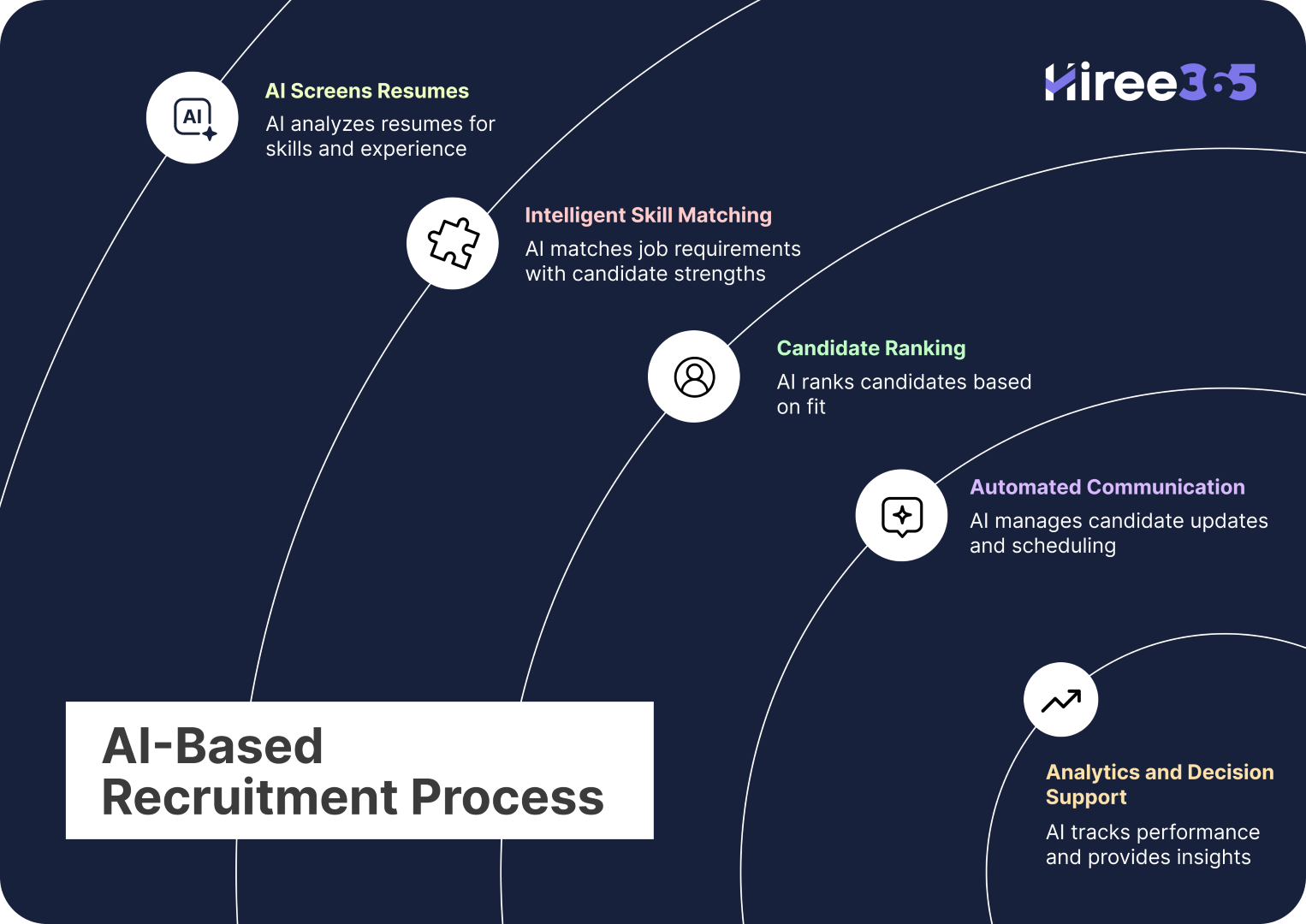
Industry Insights: Why Adoption of AI-Based Recruitment Software Is Rising
AI adoption in HR is backed by clear data and strong global trends.
Industry Stats
- 72% of HR leaders say AI helps improve candidate quality (Source: Gartner).
- 3x faster hiring is reported by companies using recruitment automation (SHRM).
- 80% of job seekers prefer timely updates and automated messages.
- AI improves resume screening accuracy by 35–50% (NACE research).
- By 2027, AI-powered talent acquisition systems will be standard in 60% of organizations.
These trends show why traditional ATS tools are becoming outdated.
Competitor Comparison: Where AI-Based Recruitment Software Stands Today
The AI hiring software market has grown quickly, and HR teams usually evaluate platforms based on automation, scalability, AI accuracy, reporting depth, and campus hiring support. The table below highlights common industry capabilities and where modern AI systems outperform older tools.
| Capability | Basic ATS Tools | Modern AI Hiring Platforms |
| Automation | Limited | Full hiring workflow automation |
| Campus Hiring | Not supported | Deep support for colleges & universities |
| Resume Analysis | Keywords only | Semantic, skill-based evaluation |
| Bulk Hiring | Slows down | Optimised for thousands of applicants |
| Role Matching | Generic | Predictive, context-based |
| Reporting | Basic | Data-rich analytics |
| Scalability | Low | High-volume enterprise ready |
This shows why more HR leaders now prefer AI-first systems like Hiree365.
The Future of Hiring With AI-Based Recruitment Software
The future of hiring is not just digital; it is predictive, automated, and intelligent.
Predictive Hiring Decisions
AI will analyse candidate success patterns and predict who will perform best.
Automated Workflows for Hybrid Teams
Remote and hybrid workplaces require smarter coordination.
AI will automate communication across multiple touchpoints.
Fair & Skill-First Hiring
AI reduces unconscious human bias and promotes diversity.
Real-Time Workforce Insights
Recruiters will rely on data-driven hiring rather than intuition.
Why Hiree365 Is a Leading Choice for AI-Based Recruitment Software
Hiree365 stands out because it brings AI, automation, ATS, and campus hiring into one platform.
End-to-End Automation
From resume screening to offer rollouts—everything is automated.
AI + ATS Integrated System
Not just tracking—intelligent decision-making.
Powerful For Agencies, Enterprises, and Universities
One platform for all hiring environments.
Enterprise-Grade Analytics
Deep insights into recruiter performance, hiring patterns, and quality metrics.
Hiring is becoming faster, more competitive, and more complex every year. HR leaders need more than an ATS—they need intelligence, automation, accuracy, and scalability. AI-based recruitment Software delivers all of this and more.
Whether you’re a corporate HR team, a recruitment agency, or a university placement cell, switching to AI isn’t just a technological upgrade—it’s a strategic advantage.
FAQ
What is AI-based recruitment software?
AI-based recruitment software is a hiring platform that uses artificial intelligence to automate resume screening, shortlist candidates, match skills to job roles, schedule interviews, and provide hiring insights. Unlike traditional ATS tools, it focuses on accuracy, speed, and predictive decision-making.
How is AI recruitment software different from a traditional ATS?
A traditional ATS mainly tracks applications and relies on keyword-based filtering. AI recruitment software goes further by understanding resume context, evaluating skill relevance, predicting job fit, and automating repetitive tasks across the entire hiring lifecycle.
Is AI-based recruitment software suitable for high-volume hiring?
Yes. AI-based recruitment software is designed for high-volume hiring environments such as enterprises, recruitment agencies, BPOs, and campus placements. It can process thousands of applications simultaneously without slowing down hiring timelines.
Can AI recruitment software improve quality of hire?
Absolutely. AI improves quality of hire by ranking candidates based on skills, experience, role relevance, and predictive performance indicators rather than manual judgment or keyword matches. This reduces mis-hires and early attrition.
Does AI-based recruitment software reduce hiring time?
Yes. Companies typically see a 60–70% reduction in screening time as AI automates resume parsing, eligibility checks, shortlisting, communication, and scheduling—significantly accelerating the time-to-hire.
Is AI recruitment software useful for small HR teams and startups?
Yes. Small HR teams benefit greatly because AI removes manual workload, reduces recruiter fatigue, and allows lean teams to handle hiring volumes efficiently without increasing headcount.
How does AI recruitment software help recruitment agencies?
For recruitment agencies, AI recruitment software helps manage multiple clients and roles, automate shortlisting, deliver faster candidate pipelines, reduce turnaround time, and improve client satisfaction—directly impacting margins.
Can AI-based recruitment software support campus hiring?
Yes. AI-powered campus recruitment software automates bulk resume screening, eligibility filtering, ranking thousands of students, managing placement drives, and providing transparent tracking for students and institutions.
Is AI recruitment software biased?
When implemented correctly, AI recruitment software reduces unconscious human bias by focusing on skills, experience, and job relevance rather than subjective factors. Many platforms also include bias-audit mechanisms and structured evaluations.
What features should I look for in AI-based recruitment software?
Key features include intelligent resume parsing, AI-based shortlisting, automated interview scheduling, multi-stage hiring workflows, campus hiring tools, analytics dashboards, and scalability for high-volume hiring.
Does AI recruitment software improve candidate experience?
Yes. Automated updates, faster responses, interview scheduling, and real-time status tracking improve transparency and reduce candidate uncertainty—leading to higher engagement and lower drop-offs.
Can AI recruitment software integrate with existing HR systems?
Most modern AI recruitment platforms integrate with HRMS, job boards, assessment tools, communication channels, and identity verification systems to create a unified hiring workflow.
Is AI-based recruitment software secure?
Yes. Enterprise-grade AI recruitment software includes role-based access, data encryption, audit logs, and compliance with data protection standards to ensure candidate and company data security.
Is switching from ATS to AI recruitment software worth it?
For fast-growing organizations, agencies, and campuses, switching to AI-based recruitment software is a strategic upgrade. It improves speed, accuracy, scalability, and hiring outcomes—far beyond what traditional ATS tools can offer.
Why is AI-based recruitment software the future of hiring?
Hiring is becoming more competitive, data-driven, and high-volume. AI enables predictive hiring, automation, fairness, and real-time insights, making it essential for modern talent acquisition strategies.