




How A University Recruiting Platform Simplifies Campus Hiring
A university recruiting platform is now essential for campuses that manage large student batches, multiple hiring cycles, and growing employer expectations. As recruitment becomes more fast-paced and diverse, ranging from internships to global remote roles, universities need a single system that helps students apply easily, assists employers in selecting candidates, and allows placement teams to coordinate everything without chaos.
Campus hiring today is nothing like it was a decade ago. Students want clear information, companies expect organised processes, and placement offices handle higher workloads than ever. This article explores how universities benefit from modern recruitment platforms, what features truly matter, what data shows about changing hiring patterns, and why structured systems lead to better outcomes for everyone involved.
The Changing Landscape of Campus Hiring
University hiring once revolved around a single annual placement season. Today, it is a continuous, multi-round cycle involving:
- Integrated internships
- Remote job roles
- Hybrid interviews
- Off-campus hiring
- Industry-linked projects
- Multiple hiring waves across the year
This shift is driven by three primary forces: student expectations, employer demands, and digital transformation.
1. Students Expect Real-Time Information and Transparency
According to the India Skills Report 2024, 67% of graduating students prefer a digital platform to track job opportunities, deadlines, shortlists, and interview schedules.
They want one place where everything is visible and reliable.
- No missed updates
- No confusion about eligibility
- No scattered PDFs and WhatsApp groups
A campus recruiting platform meets this expectation.
2. Employers Prefer Structured, Data-Ready Campuses
A SHRM recruiting study reveals that employers spend 40% less time hiring from institutions that use a digital hiring system. Why?
- Accurate student data
- Organized job pipelines
- Faster interview coordination
- Less back-and-forth communication
- Clear reporting
This environment makes campus hiring more predictable and encouraging for companies.
3. Placement Teams Are Under Pressure to Manage More Than Ever
Today’s placement offices handle:
- Multiple hiring cycles per year
- Increasing student batches
- Multi-round assessments
- Industry certifications
- Skills-matching
- Hybrid or remote drives
- Employer relationship-building
Managing all of this manually is not sustainable.
This is where the university recruiting platform plays a vital role.
The Data Behind Why Universities Adopt Recruitment Platforms
Here’s what industry research highlights:
- 71% of universities say manual placement processes reduce their ability to bring more employers. (Source: NACE)
- 62% of students miss at least one campus job deadline because of scattered communication. (Source: India Skills Report)
- Universities using an Application Tracking System (ATS) report 30–40% higher placement efficiency. (Source: Deloitte Talent Survey)
- 43% of employers avoid campuses with “unpredictable or unstructured hiring workflows.” (Source: SHRM Campus Hiring Study)
These numbers paint a clear picture: digital hiring is no longer optional.
A Realistic Narrative: A Day in the Life of a Placement Officer
To understand the impact of a campus recruitment software, imagine this:
Before
A placement officer starts the day with:
- Multiple emails from students asking if they are eligible
- Recruiter emails requesting new shortlists
- Excel sheets with outdated CGPA
- Students who missed yesterday’s interview update
- A hiring manager asking for 300 resumes “by afternoon”
- A WhatsApp message saying a student’s resume wasn’t included by mistake
After adopting a university recruiting platform
The placement officer begins the day with a dashboard that shows:
- All new job postings
- Which students applied
- Interview schedules for the week
- Recruiter feedback
- Pending tasks and upcoming deadlines
No chaos. No repeated questions. No last-minute panic. Just clarity.
This narrative mirrors what many universities experience once they adopt structured campus recruitment platform systems.
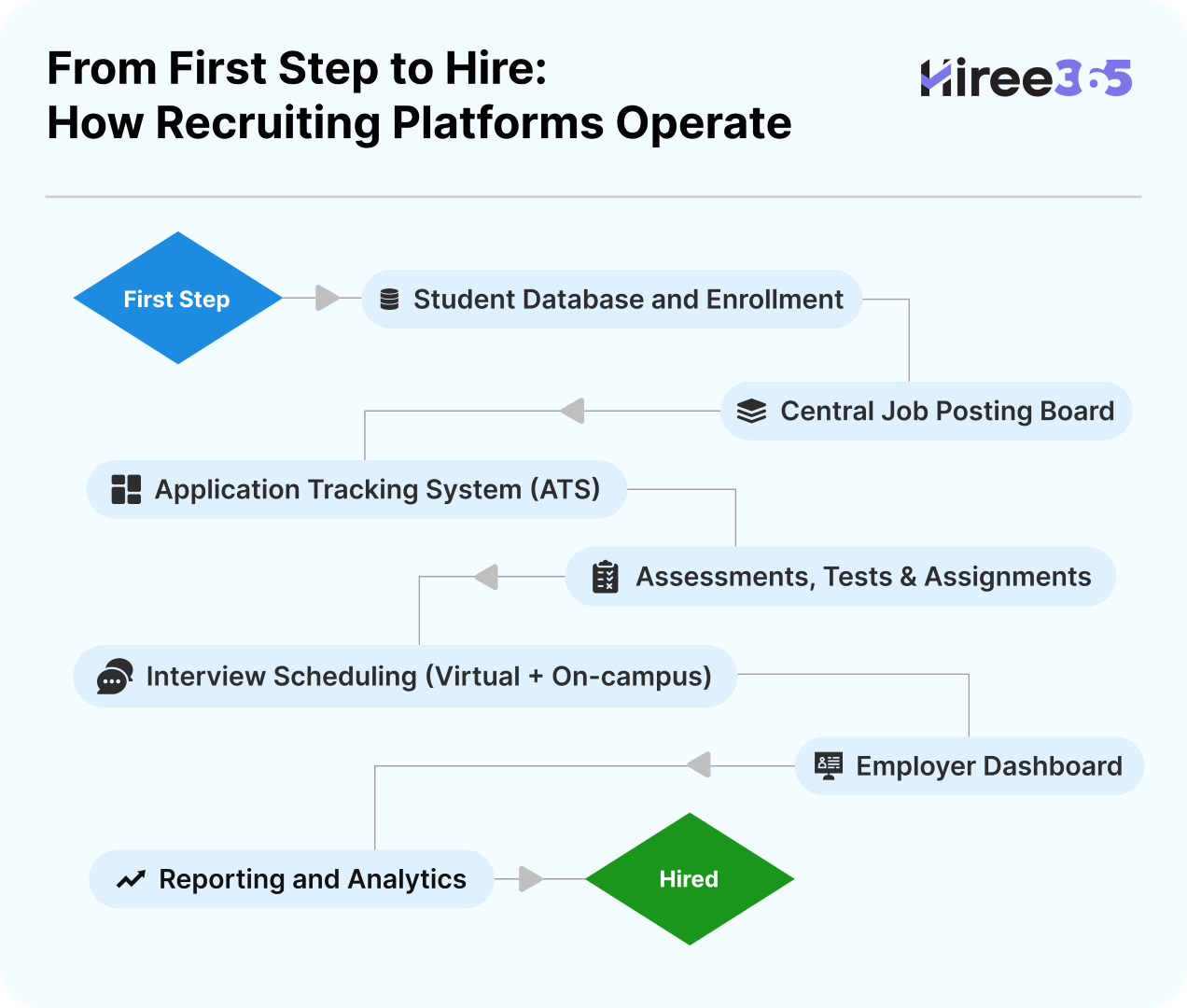
How a University Recruiting Platform Works: From Start to Finish
Below is a detailed breakdown of how these platforms function.
1. Student Database and Enrollment
Universities bulk-upload or sync student information. Students complete their profiles with academic scores, resumes, internships, and certifications.
What this solves:
- Outdated student records
- Manual errors
- Eligibility mismatches
2. Central Job Posting Board
All opportunities appear in one place:
- Internships
- Full-time jobs
- Remote roles
- Industry projects
- Off-campus hiring
Students can filter by department, salary, skills, company type, and location.
3. Application Tracking System (ATS)
The Application Tracking System becomes the core of campus hiring.
It tracks:
- Who applied
- Who is eligible
- Who got shortlisted
- Who is selected
- Who got an offer
ATS features are no longer limited to corporate hiring. Universities use them to manage large student volumes efficiently.
4. Assessments, Tests & Assignments
A campus recruitment software integrates:
- Aptitude tests
- Technical assessments
- Communication evaluations
- Coding tests
- Case-study submissions
- Group discussion tools
This replaces the need for multiple external tools.
5. Interview Scheduling (Virtual + On-campus)
Platforms support:
- Time-slot booking
- Prevention of schedule clashes
- In-person room allocations
- Zoom/Google Meet integration
- Interviewer panel management
- Automated reminders
This reduces confusion for both students and employers.
6. Employer Dashboard
Recruiters expect transparency and speed.
They can:
- Post roles
- View profiles
- Shortlist candidates
- Share feedback
- Upload outcome lists
- Coordinate interviews
Easy workflows increase employer participation the next year.
7. Reporting and Analytics
Placement teams get:
- Placement statistics
- Salary trends
- Company performance data
- Batch-wise analysis
- Program-wise hiring outcomes
- Skill gap insights
Reports that once took weeks now take minutes.
What Features Truly Matter
| Feature | Why It Matters | Impact on Students | Impact on Recruiters |
| Central Job Board | Removes scattered postings | Easy access to jobs | Better applicant quality |
| ATS Workflows | Tracks all candidate stages | Real-time updates | Faster shortlisting |
| Student Profile System | Organized resumes & data | One-click applications | Clean, verified profiles |
| Assessment Suite | Skill-based evaluation | Fair process | Quick screening |
| Interview Scheduling | Avoids clashes & confusion | Clear timings | Smooth coordination |
| Placement Reports | Helps with audits & planning | Stronger outcomes | Accountability |
| Career Guidance Tools | Increases readiness | Better resumes | More relevant applicants |
Deep Industry Insight: What Recruiters Want From Campus Hiring
Based on NACE and SHRM data:
Recruiters consistently expect:
- Reliable student data
- Accurate shortlist generation
- Fast communication
- Smooth interview management
- Fair and structured assessments
Common recruiter complaints include:
- “Shortlist was delayed.”
- “Data was incomplete.”
- “Students did not get timely updates.”
- “Schedules were changed last minute.”
A university recruiting platform reduces these pain points, creating a professional hiring environment that companies trust.
What Students Value the Most
Surveys across Indian and global universities reveal that students want:
- Clear visibility of job postings
- Instant notifications about shortlists
- Easy application process
- Guidance for resume improvement
- Transparency in selection
- A single platform for all updates
Universities adopting structured systems see higher student satisfaction scores.
1. Speed
A university recruiting platform replaces slow, manual coordination with instant application updates, automated shortlisting, and unified communication. This reduces hiring cycles significantly because placement teams no longer manage data across emails, spreadsheets, and message groups.
2. Accuracy
With a university recruiting platform, eligibility rules, academic data, and student profiles are updated automatically. This removes the common errors seen in manual systems, such as outdated records, incomplete resumes, and mismatched shortlists.
3. Transparency
A university recruiting platform gives students a central place to track job postings, deadlines, selection stages, and offers. Clear, real-time visibility removes confusion that normally comes from scattered communication channels.
4. Employer Confidence
Recruiters trust universities that use structured processes. A campus recruiting platform ensures timely shortlists, organised profiles, and predictable hiring workflows, making companies more likely to return for future hiring cycles.
5. Multi-Season Hiring Support
Modern hiring runs year-round, including internships, off-campus roles, and multiple placement rounds. A university recruiting platform allows placement teams to manage several cycles at once without conflicts or duplicated work.
6. Off-Campus & Global Opportunities
A campus recruitment platform connects students to external job boards and global openings. This expands access beyond on-campus drives and allows universities to support international hiring, virtual interviews, and remote roles effortlessly.
Market Insight: How Technology is Transforming Campus Hiring
According to Deloitte’s 2024 Talent Acquisition Report:
- Universities using recruitment platforms see a 34% reduction in manual workload.
- Students using digital portals apply to 57% more relevant roles.
- Employers using structured systems reduce hiring time by 26%.
These improvements directly relate to the efficiency of:
- A Talent Acquisition System
- Recruitment Agencies Software
- AI-Based Recruitment Software
- Campus Recruitment Software
- Application Tracking System Software
Conclusion
Campus hiring is no longer a single-season activity. It is a year-round cycle involving assessments, applications, interviews, internships, and industry collaborations. A university recruiting platform brings order, speed, accuracy, and transparency into this complex workflow. Students stay informed, employers stay engaged, and universities operate with clarity.
With growing batch sizes, multiple hiring rounds, and rising global opportunities, universities that adopt structured campus recruitment platforms, Application Tracking System software, and platforms for recruitment stand out in an increasingly competitive academic landscape.
FAQ
How does a university recruiting platform improve the end-to-end campus hiring workflow?
A university recruiting platform brings student profiles, job postings, eligibility checks, applications, assessments, interviews, and offer updates into one system. This eliminates scattered communication and gives placement teams, students, and recruiters a single, reliable workflow.
Why do universities need an Application Tracking System instead of spreadsheets?
An Application Tracking System automatically manages eligibility filters, shortlisting, stage tracking, and duplicate prevention. It is far more reliable than spreadsheets, especially when universities handle large batches, multiple departments, and several hiring rounds at once.
How does campus recruitment software support smaller colleges and universities?
Smaller institutions benefit by reducing manual workload, avoiding scheduling errors, and giving students a central place for updates. Even with limited placement staff, they can manage multiple job roles, employer requests, and student applications efficiently.
Can a campus recruiting platform increase student placement rates?
Yes. A campus recruiting platform improves placement outcomes by ensuring students apply to relevant roles, providing accurate profiles to recruiters, reducing missed deadlines, and managing selection stages clearly. This leads to more shortlists and higher offer conversions.
How does a university recruiting platform support virtual or remote hiring drives?
These platforms offer tools for online assessments, video interviews, time-slot scheduling, and automated communications. Recruiters can run complete hiring cycles remotely, allowing universities to participate in national and global hiring without logistical challenges.
Do employers prefer universities that use structured campus hiring software?
Recruiters value structured systems because they receive accurate lists, timely updates, and consistent workflows. This professionalism increases their confidence in the institution and often encourages them to return for future hiring cycles.
How does a university recruiting platform maintain eligibility accuracy?
The platform applies CGPA rules, backlog filters, department criteria, and custom employer requirements automatically. This prevents errors such as including ineligible students or missing qualified candidates.
Can these platforms for recruitment handle multiple placement seasons at once?
Yes. Modern platforms support internships, full-time roles, off-campus drives, PPI/PPO processes, and multiple hiring cycles simultaneously. Each can run with separate rules and timelines without interfering with others.
How do students benefit from a centralised campus recruitment platform?
Students get one dashboard for job postings, eligibility checks, application status, interview rounds, reminders, and offer letters. This prevents missed opportunities and reduces their reliance on scattered WhatsApp groups or emails.
Is a university recruiting platform suitable for multi-campus or large institutions?
Yes. These platforms support department-wise workflows, campus-specific dashboards, role-based access, and consolidated reporting for leadership. Each campus can operate independently while maintaining central visibility.
What analytics should universities expect from campus recruitment software?
Expected analytics include placement statistics, batch-wise outcomes, salary trends, recruiter performance, domain-wise hiring, and skill-gap insights. These reports support decision-making, accreditation needs, and curriculum planning.
How does an Application Tracking System reduce hiring delays during peak season?
An ATS reduces delays by tracking candidate progress in real time, preventing scheduling conflicts, sending automated reminders, and allowing recruiters to access accurate data instantly. This keeps multiple hiring drives moving without bottlenecks.