




Top Features To Look For In Corporate HR Recruiting Software
Modern recruitment has changed dramatically. Companies today manage global applicants, remote interviews, high-volume hiring cycles, and fast-changing skill demands. To stay ahead, organisations need Corporate HR Recruiting Software that streamlines workflows, reduces manual effort, and supports better hiring decisions through automation and data.
But with so many tools in the market, identifying the right features is crucial. This guide explains exactly what to look for, how each feature impacts your hiring outcomes, and why modern HR teams rely on automation and AI to deliver results.
This article explores corporate HR recruiting software, best HR recruiting software, recruitment automation software, top recruiting software for startups, and the benefits of HR software.
What Is Corporate HR Recruiting Software?
Corporate HR Recruiting Software is a centralized system that manages the entire hiring process, including job postings, applications, resume screening, interviews, evaluations, assessments, communication, and hiring analytics.
It replaces manual work with:
- Automated workflows
- AI-driven candidate analysis
- Real-time collaboration
- Multi-channel job posting
- End-to-end applicant tracking
This ensures consistency, visibility, and accuracy across all hiring activities.
Why Corporate HR Teams Need Modern Recruiting Software
A company’s ability to hire quickly and accurately directly affects productivity, budgets, and growth. Traditional hiring methods, email, spreadsheets, and manual screening, cannot support today’s demand for speed and precision.
Key Hiring Challenges HR Teams Face
- Managing large volumes of applicants
- Slow resume screening
- Scheduling conflicts
- Unstructured evaluation methods
- Poor candidate experience
- Limited data visibility
- Difficulty coordinating with managers
- Time-consuming communication
Modern software solves these challenges through automation, structured workflows, and centralized data.
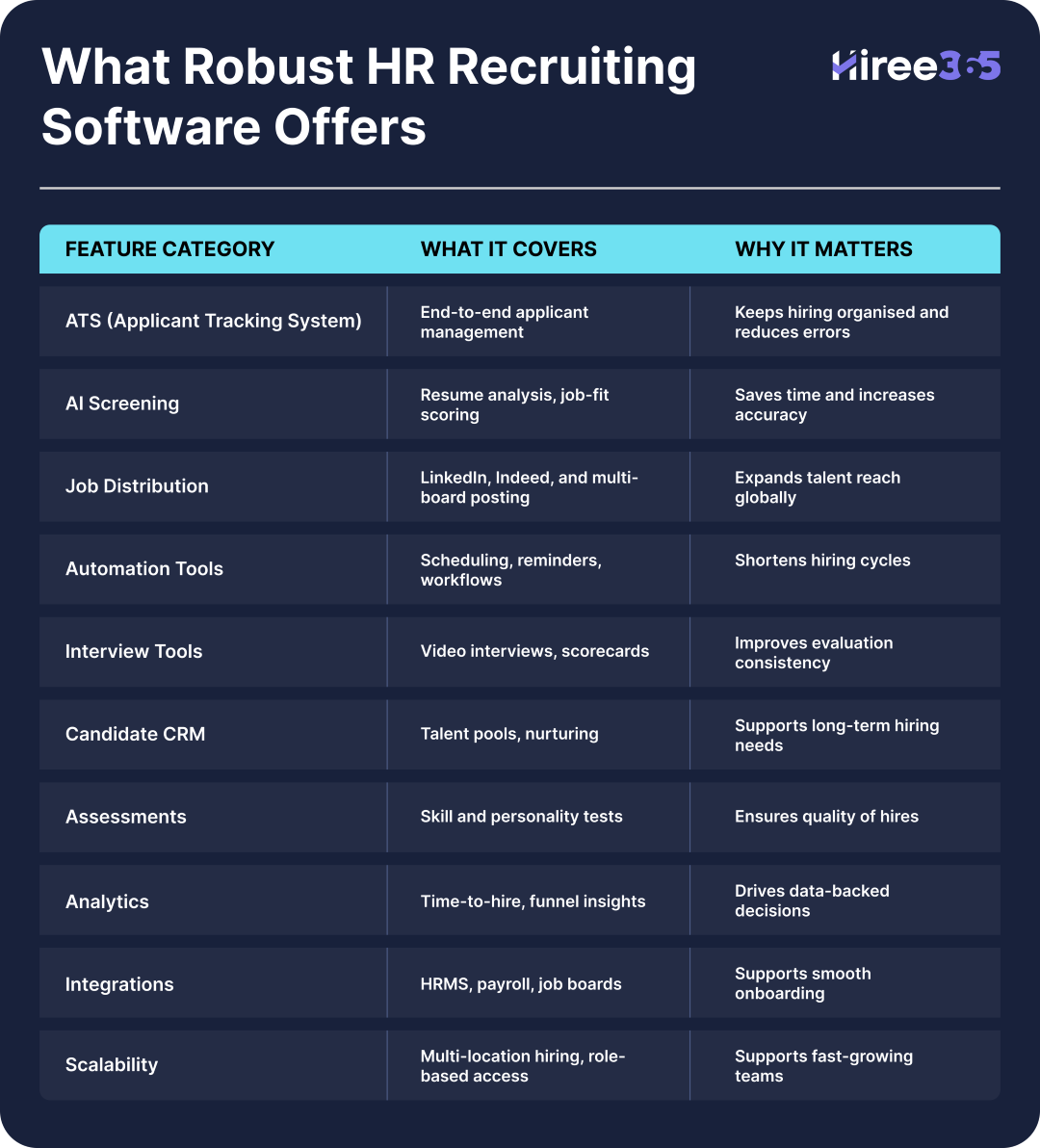
What Strong Corporate HR Recruiting Software Includes
| Feature Category | What It Covers | Why It Matters |
| ATS (Applicant Tracking System) | End-to-end applicant management | Keeps hiring organised and reduces errors |
| AI Screening | Resume analysis, job-fit scoring | Saves time and increases accuracy |
| Job Distribution | LinkedIn, Indeed, and multi-board posting | Expands talent reach globally |
| Automation Tools | Scheduling, reminders, workflows | Shortens hiring cycles |
| Interview Tools | Video interviews, scorecards | Improves evaluation consistency |
| Candidate CRM | Talent pools, nurturing | Supports long-term hiring needs |
| Assessments | Skill and personality tests | Ensures quality of hires |
| Analytics | Time-to-hire, funnel insights | Drives data-backed decisions |
| Integrations | HRMS, payroll, job boards | Supports smooth onboarding |
| Scalability | Multi-location hiring, role-based access | Supports fast-growing teams |
This structure makes it easy for HR leaders to compare software capabilities at a glance.
Top Features to Look for in Corporate HR Recruiting Software
1. A Modern Applicant Tracking System (ATS)
An ATS is the foundation of any recruiting platform. It organises all candidates, tracks their progress, and provides complete visibility across stages.
Essential ATS Capabilities
- Resume parsing
- Custom hiring pipelines
- Candidate profiles
- Collaboration with hiring managers
- Automated stage updates
- Compliance tracking
- Bulk candidate actions
Why It Matters
An ATS ensures hiring stays structured, efficient, and fully documented—critical for both startups and enterprises.
2. AI Resume Screening
Key Features
AI-based screening significantly reduces the time HR teams spend manually reading resumes.
- Contextual resume analysis
- Skills and experience mapping
- Job-fit scoring
- Eligibility checks
- Bias-reduction through standardised criteria
Impact on Hiring
AI screening enables companies to shortlist quality candidates faster, avoid human errors, and handle high-volume hiring with ease.
3. Multi-Channel Job Posting (LinkedIn, Indeed, & More)
The right software should allow HR teams to publish job postings across platforms simultaneously.
Supported Channels May Include
- Indeed
- Naukri
- Monster
- Google for Jobs
- Glassdoor
- ZipRecruiter
Why It Matters
Multi-board posting increases visibility, reduces time spent manually uploading listings, and supports global talent sourcing.
4. Recruitment Automation Software Features
Automation is a defining feature of modern HR software. It removes repetitive tasks and helps teams operate at scale.
Common Automation Capabilities
- Automated interview scheduling
- Email and SMS notifications
- Trigger-based workflows
- Auto-screening filters
- Hiring manager alerts
- Candidate movement between stages
Why Automation Is Essential
It accelerates hiring cycles, improves consistency, and frees HR teams to focus on strategic decision-making.
5. Interview Intelligence & Scheduling Tools
Interview management often becomes a bottleneck in hiring. Intelligent interview tools ensure structure and reduce delays.
Features to Look For
- Video interview platforms
- AI interview evaluations
- Skill-based question banks
- Interview scorecards
- Scheduled workflows
- Calendar integrations (Google, Outlook)
Benefits
These tools ensure interviews are fair, objective, and aligned with company standards.
6. Candidate Relationship Management (CRM)
Talent pipelines are an essential asset for any HR team. A CRM helps nurture candidates even when no immediate role exists.
Capabilities of a Strong CRM
- Talent pooling
- Segmented candidate lists
- Engagement scoring
- Follow-up reminders
- Re-engagement campaigns
Why It’s Important
A CRM supports long-term hiring strategies and reduces cost-per-hire over time.
7. AI Assessments & Skills Testing
Companies increasingly prefer hiring for verified skills rather than relying solely on resumes.
Common Assessment Types
- Technical challenges
- Cognitive and aptitude tests
- Communication assessments
- Job simulations
- Domain-specific tests
Hiring Impact
Skill assessments help ensure candidates can perform effectively from day one.
8. Recruitment Analytics & Dashboards
Decision-making in HR needs to be data-backed. Analytics provide a clear overview of hiring performance.
Key Metrics to Track
- Time-to-hire
- Source-of-hire effectiveness
- Drop-off stages
- Offer acceptance rates
- Candidate pipeline health
- Recruiter productivity
Why Analytics Matter
Companies can identify bottlenecks, optimise sourcing channels, and improve overall hiring efficiency.
9. Integrations With HRMS, Payroll, and Job Boards
Hiring should connect seamlessly with HR operations.
Common Integrations
- HRMS platforms
- Payroll systems
- Assessment tools
- Job portals
- Calendar apps
- Onboarding systems
- Single Sign-On (SSO)
Benefits
Integrations reduce data duplication, support compliance, and simplify onboarding.
10. Scalability for Startups and Large Enterprises
Whether a company is hiring 10 people or 1,000 people, the software must adapt.
For Startups
- Flexible pricing
- Quick deployment
- Simple UI
- Automation-first approach
For Enterprises
- Multi-location support
- Advanced permissions
- High-volume hiring tools
- Compliance and audit logs
- API access
Scalable systems grow with your organisation and eliminate the need for future migration.
Benefits of HR Recruiting Software for Corporate Hiring
Key Advantages
- Faster hiring cycles
- Reduced administrative workload
- Improved candidate experience
- Enhanced quality of hire
- Higher recruiter productivity
- Centralised data
- Better communication
- Consistent evaluation
- Global hiring readiness
- Lower overall hiring costs
This satisfies the “benefits of HR software” keyword with a structure designed for Featured Snippets.
How to Choose the Best Corporate HR Recruiting Software
Below is a practical decision matrix.
Decision Table
| Evaluation Criteria | Why It Matters | Questions to Ask |
| Automation | Saves time and reduces errors | Which tasks can be automated? |
| AI Intelligence | Improves screening accuracy | Does it include contextual scoring? |
| Integrations | Ensures smooth operations | Does it connect with existing tools? |
| Analytics | Helps measure hiring impact | Does it track essential KPIs? |
| Usability | Affects adoption rate | Is it easy for teams to use? |
| Scalability | Supports future growth | Can it handle increased hiring volumes? |
| Pricing | Impacts long-term value | Is it flexible and transparent? |
Corporate HR Recruiting Software vs Recruitment Automation Software
Corporate HR Recruiting Software
A full hiring ecosystem featuring ATS, CRM, automation, AI tools, dashboards, and integrations.
Recruitment Automation Software
A specialized tool focused mainly on automating specific hiring steps like screening, scheduling, and messaging.
Most growing companies use software that combines both capabilities.
Conclusion
Choosing the right Corporate HR Recruiting Software is essential for building a scalable, efficient, and competitive hiring strategy. Look for platforms that combine automation, AI capabilities, multi-channel sourcing, structured interview tools, and analytics.
The right software transforms recruitment from a manual, time-consuming function into a strategic, data-driven engine that supports company growth.
FAQ
What features should Corporate HR Recruiting Software have for high-volume hiring?
For high-volume recruitment, the software should include AI resume screening, automated workflows, multi-job board posting, bulk applicant actions, and a robust ATS capable of handling thousands of profiles without lag or data loss.
How does AI-powered screening improve corporate hiring results?
AI-powered screening analyzes resumes based on skills, experience relevance, and job-fit context rather than simple keyword matching. This reduces manual screening time, improves accuracy, and ensures strong candidates are prioritised early in the hiring funnel.
What are the real business benefits of using Corporate HR Recruiting Software?
Businesses benefit from faster hiring cycles, improved quality of hire, reduced administrative work, structured interview processes, better communication with candidates, and enhanced collaboration between HR teams and hiring managers.
Is recruitment software useful for early-stage or fast-growing startups?
Yes. Startups benefit from automation, instant job posting across multiple boards, simplified workflows, and AI-based screening that helps them manage hiring even with small HR teams or limited resources.
At what stage should a startup invest in HR recruiting software?
A startup should consider HR recruiting software when hiring more than 5–10 roles monthly, expanding across teams, needing repeatable interview processes, or dealing with candidate volumes that require structured tracking and automation.
Why do enterprises require specialized corporate recruiting software?
Enterprises need features like role-based access, custom approval flows, compliance logs, SSO, advanced reporting, bulk actions, and department-specific hiring pipelines to manage complex, multi-location recruitment operations efficiently.
Can corporate HR recruiting software handle multi-country or global hiring needs?
Yes. Modern software includes GEO-friendly workflows, global job board integrations, timezone-adjusted scheduling, multi-language support, and region-specific compliance tools to streamline multi-country hiring.
How does multi-job board posting help corporate HR teams?
Multi-job board posting increases applicant reach by publishing a job once and distributing it across LinkedIn, Indeed, Naukri, Glassdoor, and other platforms. It saves time, attracts diverse candidates, and helps HR teams analyse which platforms perform best.
Does HR recruiting software improve the quality of interviews?
Yes. Features like structured scorecards, question templates, evaluation criteria, AI interview analysis, and automated scheduling ensure interviews are consistent, objective, and aligned with role requirements.
How does HR software reduce hiring costs?
HR software reduces hiring costs by automating manual tasks, improving recruiter productivity, lowering dependency on external agencies, and identifying cost-effective sourcing channels through analytics and performance reports.
What security or compliance features should corporate hiring software have?
Essential compliance features include encrypted data storage, GDPR-ready policies, audit trails, role-based user permissions, SSO, secure access controls, and document tracking to protect sensitive candidate information.
Can corporate HR software integrate with existing HRMS or payroll tools?
Most modern recruiting systems integrate with HRMS platforms, payroll systems, background screening providers, job portals, email clients, and calendar tools to create a seamless flow from hiring to onboarding.