


Government recruitment software has become essential for modern public-sector hiring, especially as departments face growing compliance demands, tighter budgets, and increasing pressure for transparency. Today, using an Applicant Tracking System for government is no longer optional; it is a strategic requirement. With rising expectations for fairness, speed, and accuracy, digital tools are bringing new efficiency to the historically slow and paperwork-heavy government hiring ecosystem.
In this blog, we explore the biggest recruitment challenges in government and demonstrate how ATS benefits for government hiring help teams build compliant, efficient, and citizen–centric hiring processes.

Why Government Hiring Needs Modern Government Recruitment Software
Government hiring is different from corporate recruitment for one simple reason: the public sector is accountable not just to internal stakeholders but to citizens, auditors, and regulatory bodies. Every hiring decision must be fair, traceable, and backed by transparent documentation.
Modern government recruitment software is designed to address these unique demands. Unlike generic solutions, public-sector ATS tools offer audit logs, compliance workflows, structured documentation, and multi-department approval routing.
Government Hiring vs. Corporate Hiring: What’s Different? (Table)
| Factor | Corporate Hiring | Government Hiring |
| Application Volume | Moderate | Very High |
| Compliance Requirements | Flexible | Strict, legally bound |
| Approval Levels | 1–2 | 4–6 (department, panel, HR, committee) |
| Documentation | Limited | Mandatory & audit-ready |
| Transparency | Internal | Public & legally required |
| Hiring Speed | Fast | Slow due to structured protocols |
As is evident, the Recruitment challenges in government are deeply linked to its structural design, making automation a necessity, not an add-on.
Recruitment Challenge 1: Extremely High Applicant Volume
One of the most common recruitment challenges in government is the massive number of applications received for even junior-level positions. A single clerk opening may attract 5,000–15,000+ applicants, overwhelming HR teams.
Manual sorting leads to:
- Delayed shortlisting
- Human error in eligibility verification
- Inconsistent evaluation scoring
- Missed deadlines
This is where an Applicant Tracking System for government becomes transformative.
How Government Recruitment Software Solves High-Volume Screening
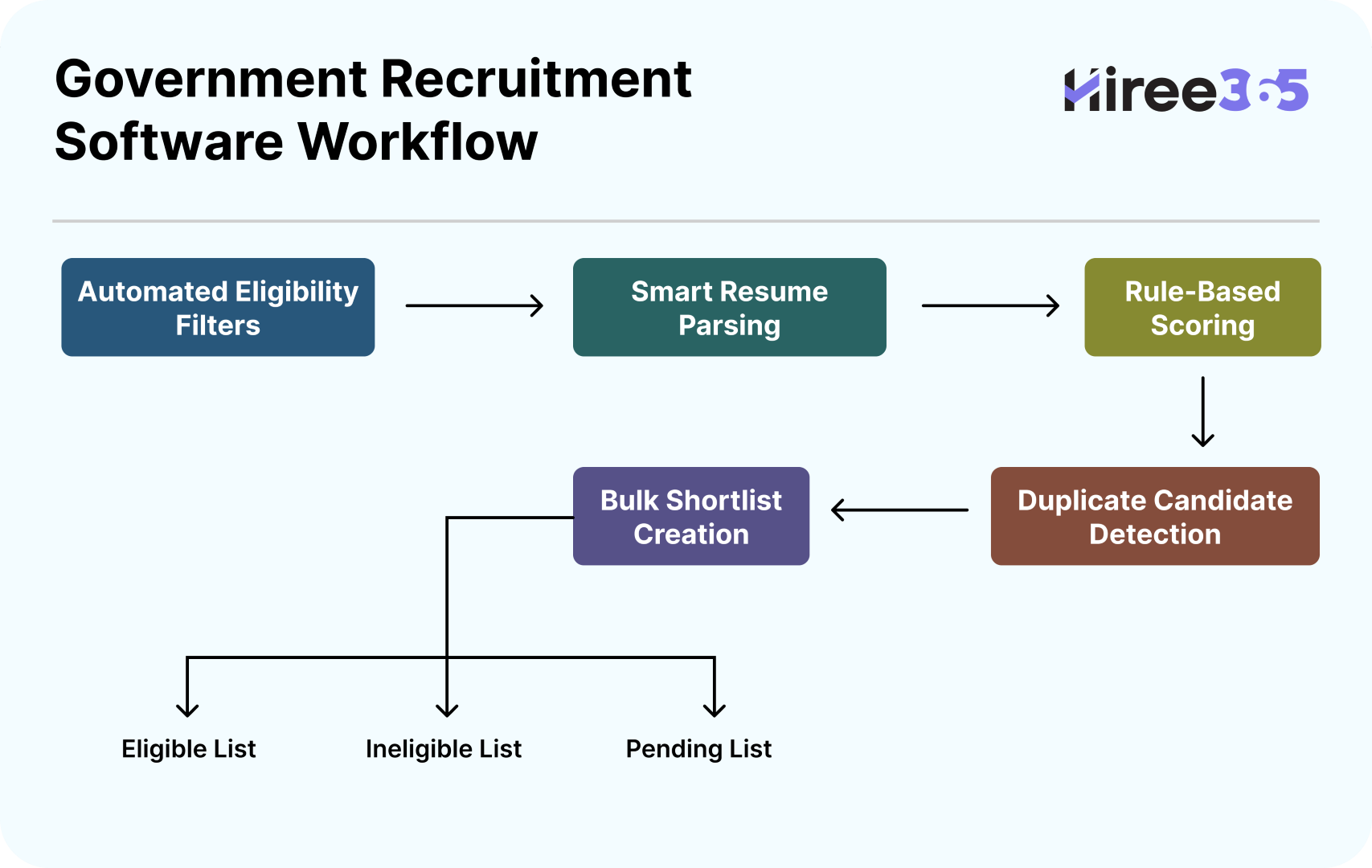
Modern ATS tools automate the end-to-end shortlisting workflow.
Key Capabilities (with Explanations)
| ATS Feature | How It Helps Government Hiring |
| Automated Eligibility Filters | Screens candidates by age, category, qualification, and experience based on government norms. |
| Smart Resume Parsing | Extracts structured data from thousands of resumes within minutes. |
| Rule-Based Scoring | Applies uniform scoring rules (merit, category, qualification weightage). |
| Duplicate Candidate Detection | Flags candidates applying multiple times under different categories. |
| Bulk Shortlist Creation | Generates panel-ready eligible, ineligible, and pending lists in one click. |
Instead of spending weeks manually sorting, teams finish the process in hours, significantly improving process efficiency.
Recruitment Challenge 2: Compliance, Documentation, and Legal Accountability
Government hiring must follow strict rules defined by:
- Central government guidelines
- State service regulations
- RTI norms
- Reservation laws
- Audit and finance approvals
The responsibility to maintain an error-free, traceable hiring trail is critical.
How an Applicant Tracking System for Government Ensures Compliance
A government-focused ATS automatically controls documentation and logs every action.
Compliance Features of Government Recruitment Software
| Compliance Need | ATS Solution | Explanation |
| Audit-Ready Records | Time-stamped logs | Every action—score change, shortlist update, approval—is recorded. |
| Reservation Management | Automated category rules | Ensures SC/ST/OBC/EWS seat allotment matches legal guidelines. |
| RTI Compliance | Centralized documentation | ATS stores data needed for public disclosures and RTI responses. |
| Approval Workflow Controls | Multi-level routing | Department heads, HR, and committees can approve digitally. |
| Secure Data Storage | Role-based access | Ensures only authorized officials can view sensitive data. |
This reduces the risk of legal disputes and makes audit inspections faster and more transparent.
Recruitment Challenge 3: Slow and Complex Multi-Level Approvals
Government hiring requires approvals from multiple layers:
- Department Head
- HR Cell
- Technical Committee
- Selection Board
- Finance Department
- Final Authority
These staggered approvals cause major delays.
How Government Recruitment Software Speeds Up Approvals
An ATS centralizes the entire process into a unified dashboard.
How Automated Approval Routing Works
- A requisition is raised by a department.
- The system automatically sends it to the right authority.
- Approvers receive notifications and reminders.
- All comments, approvals, or rejections are captured.
- The final output is audit-ready.
In traditional settings, this takes 2–8 weeks. With an ATS, it compresses to 3–5 days.
Recruitment Challenge 4: Ensuring Fairness & Transparency
Citizen trust is the backbone of public-sector hiring. However, without standardized tools, ensuring complete fairness becomes difficult.
Manual hiring risks:
- Biased shortlisting
- Missing documentation
- Non-native scoring formats
- Human error leading to legal disputes
- RTI-related inconsistencies
ATS Benefits for Government Hiring: Transparency Version
Government recruitment software ensures consistent and transparent hiring workflows:
- Standardized scoring sheets for all recruitment panels
- Automated candidate ranking based purely on merit rules
- Real-time status visibility for candidates
- Public notifications are auto-generated from the system
- Accurate documentation for RTI replies
This enhances public confidence and protects departments from legal challenges.
Recruitment Challenge 5: Long Hiring Timelines
Government hiring is known for extended timelines caused by:
- Verification delays
- Manual document checks
- Dependency on physical meetings
- Paper-based workflows
- Slow inter-departmental flow of information
With an increasing workload, departments cannot afford slow cycles.
How an Applicant Tracking System for Government Reduces Time-to-Hire
An ATS accelerates hiring by automating all time-consuming steps:
Key Time-Saving ATS Features
| Delay Factor | ATS Automation | Result |
| Manual resume screening | Auto-filtering & ranking | Weeks saved |
| Document verification | Digital uploads & validation | Accuracy improved |
| Internal approvals | Digital routing | Faster decisions |
| Exam/interview scheduling | Auto-calendar integration | Minimal back-and-forth |
| Compliance checks | Built-in rules | Fewer rejections |
Departments typically reduce hiring timelines by 40–60%.
Recruitment Challenge 6: Managing Exams, Interviews, and Final Selections
Government hiring often involves:
- Written tests
- Skill assessments
- Physical tests
- Interviews
- Medical evaluations
Managing these manually is extremely complex.
ATS Benefits for Government Hiring in Post-Screening Stages
Government recruitment software automates end-to-end coordination:
- Generate hall tickets
- Map candidates to exam centers
- Assign panel members
- Capture digital interview scorecards
- Create final merit lists automatically
- Publish results online
This not only improves speed but also ensures a digital paper trail for every decision.
Recruitment Challenge 7: Inefficient Candidate Communication
Government candidates expect frequent updates, especially because hiring cycles are long.
Common issues:
- No centralized messaging
- Incorrect contact data
- Manual communication errors
- Large-scale communication costs
How an ATS Improves Candidate Experience for Government Hiring
Applicant Tracking Systems for government replace manual communication with automated workflows:
- SMS/email updates at every stage
- Auto-notifications for document verification
- Real-time status tracking
- Candidate portals
- Admit card downloads
- Result publishing
A positive communication flow reduces frustration and prevents RTI queries related to hiring status.
Recruitment Challenge 8: Manual Document Verification & Background Checks
Government roles require strict verification of:
- Caste certificates
- Domicile
- Age
- Experience
- Education
- Identity
- Previous employment
Doing this manually is error-prone and extremely slow.
How Government Recruitment Software Streamlines Verification
Features include:
- OCR-based document extraction
- Automated mismatch detection
- Auto-verification checklists
- Integration with verification databases
- Digital stamping for approved documents
This ensures accuracy and speeds up onboarding.
Key ATS Benefits for Government Hiring
| ATS Benefit | Relevant Government Challenge | Why It Matters |
| Automated Shortlisting | High application volume | Increases fairness and reduces manual effort. |
| Compliance & Audit Logs | RTI, legal accountability | Protects departments from disputes. |
| Multi-Level Approval Routing | Slow decision-making | Speeds up processes by up to 60%. |
| Real-Time Candidate Status | Transparency issues | Builds citizen trust. |
| Digital Exam/Interview Management | Operational complexity | Reduces workload on HR and admin teams. |
| Centralized Document Management | Paper-heavy workflows | Eliminates lost files and errors. |
| Secure Data Controls | Sensitive information | Ensures confidentiality and proper access. |
Choosing the Right Government Recruitment Software: A Practical Checklist
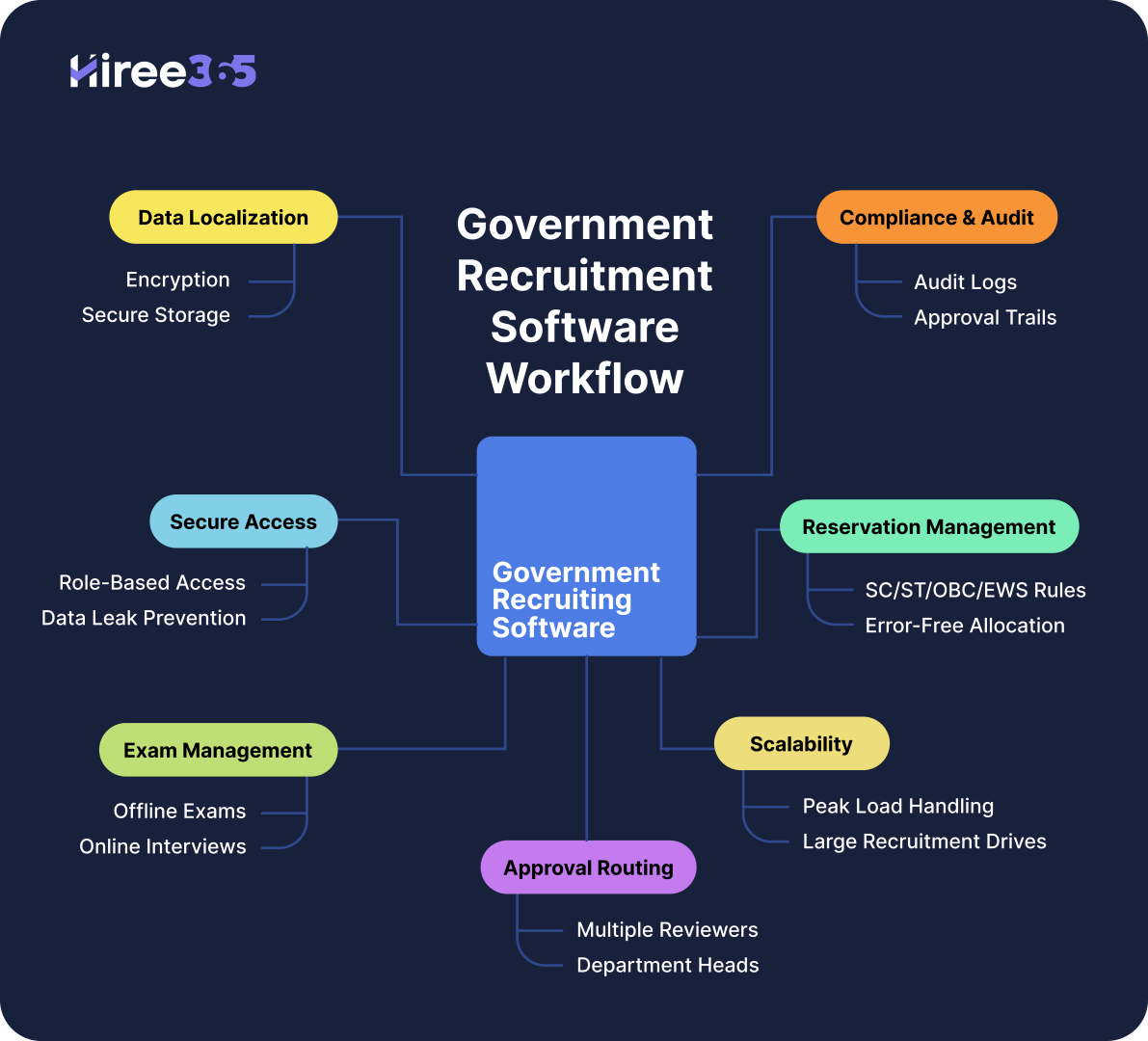
Selecting the right Government recruitment software is crucial for departments that handle high-volume hiring, strict compliance needs, and multiple approval layers. Before finalizing an Applicant Tracking System for the government, HR teams should evaluate the following:
Strong Compliance & Audit Capabilities
Government hiring must be transparent. Ensure the software creates detailed audit logs, approval trails, and RTI-friendly reports. This helps reduce recruitment challenges in government such as missing records or manual paperwork.
Reservation & Category Management
A government-ready ATS should automatically support SC/ST/OBC/EWS reservation rules. This ensures fair, error-free allocation and simplifies one of the biggest ATS benefits for government hiring accuracy.
Scalable High-Volume Application Processing
Government departments often receive thousands of applications. Your system should be able to handle peak loads without slowing down or crashing, especially during large recruitment drives.
Multi-Layer Approval Routing
Look for workflows built for government structures—multiple reviewers, department heads, and approval checkpoints. A good Applicant Tracking System for government should match your hierarchy, not force you to adjust.
Exam & Interview Management Tools
Whether you conduct written exams, skill tests, or panel interviews, the ATS should support both offline and online evaluation workflows. This reduces manual coordination and speeds up hiring decisions.
Secure, Role-Based Access
With different departments involved, data access must be controlled. The right government recruitment software ensures each user only sees what they need—improving security and preventing data leaks.
Data Localization & Government-Grade Security
All sensitive data should remain within approved servers or regions. Look for encryption, secure storage, and compliance with government IT policies.
Final Verdict: Why Every Government Team Needs an ATS
The recruitment challenges in government aren’t small, compliance pressure, workload, documentation, and public scrutiny make hiring extremely complex. A modern Applicant Tracking System for government resolves these challenges at their root.
By adopting the right government recruitment software, departments can achieve:
- Faster shortlisting
- Accurate compliance
- Less manual paperwork
- Increased transparency
- Cleaner audit records
- Improved citizen trust
- 40–60% reduced hiring time
Government hiring is evolving, and the future is digital. The departments that adopt modern ATS solutions will stand out as transparent, efficient, and citizen-friendly organizations.
FAQ
What is Government Recruitment Software and why do departments need it?
Government recruitment software is a specialized hiring system designed to support public-sector departments with high-volume applications, strict compliance requirements, documentation needs, and transparent processes. An Applicant Tracking System for government ensures fairness, audit readiness, and efficiency across the entire recruitment workflow.
How does an Applicant Tracking System for government improve hiring transparency?
An Applicant Tracking System for government maintains digital logs of scoring, shortlisting, approvals, and communication. It standardizes evaluation formats, auto-generates public notifications, and supports RTI compliance. This ensures complete accountability and improves citizen trust in the hiring process.
What are the biggest recruitment challenges in government today?
Government departments face challenges such as heavy application loads, long approval cycles, extensive documentation, strict compliance rules, manual verification processes, and inefficient communication. Government recruitment software helps resolve these challenges through automation and centralized workflows.
How does government recruitment software handle large application volumes?
It uses automated eligibility checks, resume parsing, rule-based scoring, duplicate detection, and bulk shortlisting to process thousands of applications quickly and accurately. This directly addresses one of the primary recruitment challenges in government: manual screening delays.
Is an ATS beneficial for government hiring even in small departments?
Yes. Even small municipal bodies, district offices, and government institutions require compliance, documentation accuracy, and transparent hiring. An ATS benefits government hiring by automating repetitive tasks and improving transparency at every stage.
How does an ATS ensure compliance with government hiring norms?
An ATS ensures compliance through audit trails, reservation management, centralized documentation, multi-level approval workflows, and role-based access. These features make recruitment legally sound and reduce the risk of disputes.
Can an Applicant Tracking System for government support reservation and category-based hiring?
Yes. Government-ready ATS platforms include built-in logic for SC/ST/OBC/EWS reservation, providing error-free category distribution, accurate merit lists, and legally compliant outcomes.
How does government recruitment software reduce time-to-hire?
It accelerates hiring by automating shortlisting, document verification, inter-department approvals, exam scheduling, communication, and compliance checks. Departments typically reduce hiring timelines by 40–60%.
Does an ATS help in managing exams and interviews for government hiring?
Yes. Government recruitment software supports hall ticket generation, exam-center mapping, panel assignment, digital scoring, merit list creation, and online result publishing—offering a seamless and audit-ready evaluation process.
How does an ATS benefit candidates applying for government jobs?
Candidates receive automated SMS/email updates, real-time status tracking, downloadable admit cards, clear communication, and faster results. This reduces uncertainty and improves the overall experience.
What security features should Government recruitment software include?
Key features include role-based access, encryption, data localization, secure document storage, and detailed activity logs. These ensure compliance with government data-handling standards.
How does an ATS streamline document verification in government hiring?
It uses OCR-based extraction, automated mismatch alerts, verification checklists, digital approvals, and database integrations to ensure fast and error-free verification of essential documents.
What is the difference between government recruitment software and corporate ATS tools?
Government recruitment software includes public-sector-specific capabilities such as reservation management, RTI-ready logs, strict audit trails, and multi-layer approval routing—features not typically found in corporate recruiting systems.
Can government departments customize workflows inside an ATS?
Yes. Departments can configure scoring rules, approval levels, document requirements, reservation logic, and communication templates to align with their recruitment policies.
What should departments evaluate before selecting government recruitment software?
Departments should assess compliance features, scalability, reservation handling, approval routing, exam management tools, data localization, and security standards to avoid long-term recruitment challenges in government.
How does government recruitment software help during RTI requests?
The ATS stores structured data—application logs, scoring sheets, approvals, and communication history—which allows teams to respond to RTI queries quickly and accurately without manual compilation.
Is an ATS mandatory for government hiring?
While not legally mandatory, an Applicant Tracking System for government has become essential due to rising audit, RTI, and compliance expectations. Most departments now adopt ATS platforms to streamline and modernize hiring.
Can government recruitment software integrate with other government systems?
Yes. Many ATS platforms integrate with identity verification systems, HRMS, exam platforms, and government databases to create unified and efficient workflows.
How do ATS benefits for government hiring improve administrative efficiency?
ATS benefits include structured shortlisting, automated compliance, centralized documentation, faster approvals, and real-time communication—reducing administrative burden and improving internal productivity.
What long-term advantages do government departments gain from using ATS tools?
Long-term advantages include consistent accuracy, transparent hiring, fewer legal disputes, digitized documentation, improved candidate experience, reduced hiring timelines, and strengthened public trust.